Skye ReichEcology · Materials · Public Art
A wide black-and-white sky of drifting clouds with birds in flight.
Portfolio 2026Interdisciplinary Artist

Skye Reich

An interdisciplinary artist working at the intersection of ecology, materials, and public interaction, translating ecological processes into immersive experiences.

§ About
Portrait of Skye Reich wearing a wide-brimmed hat outdoors.
Skye Reich

I'm Skye, an interdisciplinary artist grounded in science and cultivation, fascinated by the intersection of ecology, public interaction, and materials. My work balances environmental advocacy with hands-on experimentation, translating ecological processes into immersive experiences. Through my projects, I aim to spark curiosity, provoke reflection, and create meaningful encounters between people, materials, and the world around them.

Education

University of Massachusetts, AmherstMay 2023

B.S. Sustainable Community Development — Concentration: City & Society

B.S. Natural Resource Conservation — Concentration: Environmental Conservation

Experience

Jen Lewin Studio2016, 2017, 2022 · 2023–2025 · 2026–presentCreative Operations Manager; Summer Intern / Apprentice

Canova HomeSept 2021–present · seasonalJewelry Designer & Sales Associate

Magic Wings Butterfly ConservatorySept 2022–May 2023Educator & Conservation Technician

A large illuminated moth sculpture with violet and magenta wings suspended in a dark tree canopy.
01

Atlas

An interactive sculpture of 24 suspended moths, drawn from endangered species of North America.

Atlas — Courtesy of Jen Lewin Studio · Photo by Nicki Evens
Role
Project Lead · Researcher · Fabricator
Collaboration
Lead artist Jen Lewin · Jen Lewin Studio
Materials
Aluminum, UV-printed speaker mesh, LEDs, spring suspension
Type
Traveling interactive public installation

Overview

Atlas is an interactive sculpture of 24 suspended moths, their forms and wing patterns drawn from 24 endangered moth species of North America.

As visitors move beneath the suspended bodies, the moths ignite with color and sound, creating a dynamic, immersive encounter. Connecting these endangered species to a global view foregrounds the balance of our ecosystems and the interconnectedness of life on Earth.

Two glowing moth sculptures in flight formation against a dark night sky.
Suspended moths ignite as visitors pass beneath.
Three richly lit moth sculptures in red and blue hovering among dark branches.
Atlas — Courtesy of Jen Lewin Studio · Photo by Nicki Evens

My role

I was involved in Atlas from its inception, serving as primary project lead in close collaboration with artist Jen Lewin. I led Lepidoptera research, wing-design prototyping, and the development of AI-trained wing graphics. I managed client communication, coordinated with stakeholders, and directed material research for outdoor durability — printed surfaces, adhesives, and hardware.

I worked hands-on in the fabrication and assembly of the wings and bodies, and in installation: managing a team of installers and making on-site adjustments in response to environmental and aesthetic conditions. Throughout, I worked closely with Lewin to oversee the full project lifecycle, ensuring a durable, traveling sculpture capable of repeated installations with minimal refurbishment.

Visitors walking beneath a canopy of illuminated moths strung between live oak branches at dusk.
Installed beneath a live-oak canopy — the moths respond to people moving below.
Research

This research explored how endangered Lepidoptera could be communicated through visual and interactive design without text. Species selection was guided by global conservation standards, geographic diversity across North America and Hawaiʻi, and representation of multiple moth families to highlight ecological roles and pollination diversity.

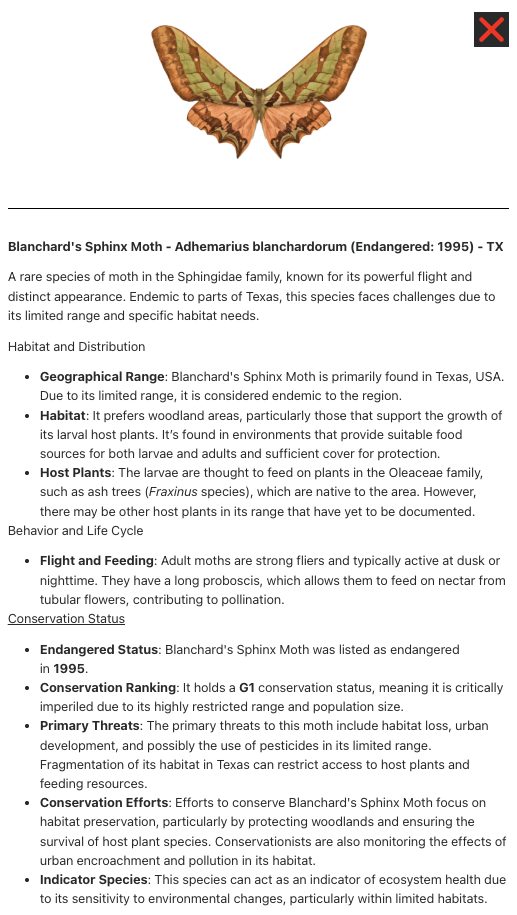
For each species, research briefs covered geographic range, preferred habitats, host plants, conservation status, and ongoing conservation efforts. An accompanying summary on ecological significance — pollination, prey relationships, indicator species, population trends, light pollution, habitat restoration, and community science — was published on the client's website as a public educational resource.
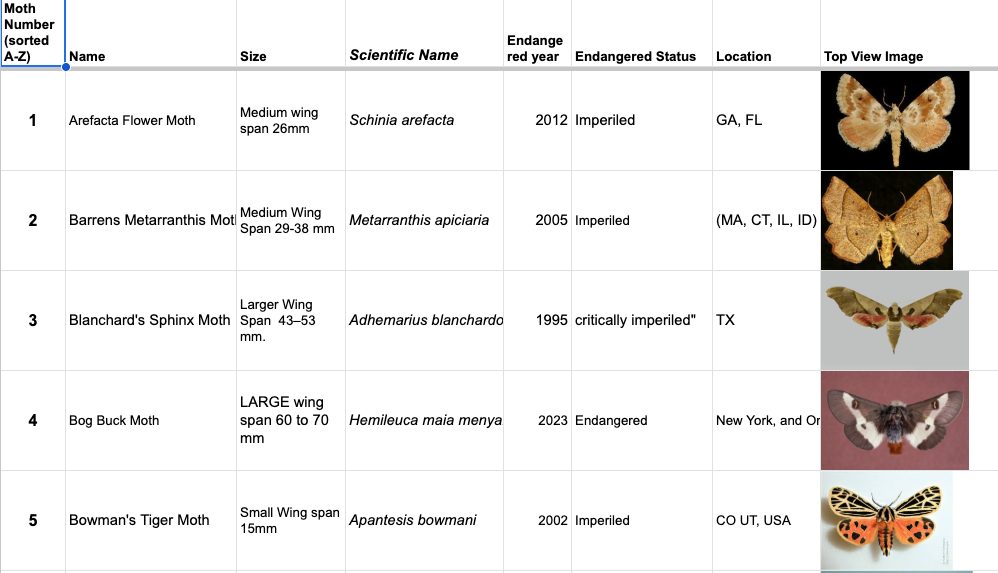
A species-selection table listing moth name, size, scientific name, endangered status, and location.
Species-selection table
A sample research brief for Blanchard's Sphinx Moth covering range, habitat, host plants, and conservation status.
Sample research brief — Blanchard's Sphinx Moth
AI Training

Hundreds of reference images were collected from scientific and insect-documentation sources to train models for the 24 endangered moths represented in Atlas. Because these species are rare, images of preserved specimens were used to study wing pattern and morphology. Generated outputs were then extensively refined in Adobe Suite to ensure both biological accuracy and large-scale visual impact, drawing out the artistic elements needed for the final installation. All results were made public to help increase knowledge of the species.

Reference specimen: moth with yellow eyespots. Reference specimen: pair of eyespotted moth wings on a branch. Reference specimen: grey moth with orange eyespots. Reference specimen: brown moth with dark eyespots. Reference specimen: small moth resting on the ground. Reference specimen: moth with pink-tinged wings. Reference specimen: moth with symmetrical eyespots. Reference specimen: broad-winged moth with eyespots. Reference specimen: moth with mottled brown wings. Reference specimen: moth with orange and grey wings. Reference specimen: moth with pale banded wings. Reference specimen: moth with dark-centred eyespots.
A composed, symmetrical moth graphic with amber and pink eyespots, refined for the installation.
Final wing graphic after refinement in Adobe.

Reference specimens above were used solely for research and public education. Outputs were verified for biological accuracy before fabrication.

Fabrication

Atlas was constructed with hand-bent aluminum frames, UV-printed speaker mesh, adjustable spring-suspension systems, and integrated LEDs. I worked directly with aluminum, epoxy, gesso, UV-reactive pigments, hinges, and modular mounting systems — prioritizing durability, repairability, and adaptability for repeated installations.

Pencil sketch of a moth wing laid out on a worktable. Studio worktables with wing frames in progress. A hand smoothing UV-printed mesh over a wing form. Close detail of a printed wing showing eyespot pattern. Hands fitting a metal bracket to an aluminum wing frame. A wing outline glowing under UV light in a darkened room.
Close-up of a moth wing glowing electric blue under ultraviolet light.
UV-reactive pigments reveal a second pattern under ultraviolet light.

Reflection

Atlas was my first experience managing all stages of a large-scale public-art project, deepening my understanding of material systems, ecological research, and public engagement. Designing for impact meant balancing aesthetics, interactivity, and long-term durability. By embedding ecological research into an interactive system, Atlas works as both artwork and educational tool, encouraging reflection on biodiversity loss and human responsibility. I'm grateful to Jen Lewin for the opportunity to collaborate on this work.

A rendered figure of a woman with a burning globe above her, dissolving into orange flame.
02

Woman in a
Burning World

Thermochromic pigment as a passive, material-based warning system for extreme urban heat.

Concept rendering
Stage
Research phase · renderings 2026 · mural planned 2027
Materials
Thermochromic pigment, UV resin, paint
Partners
ECHOGLOWS · iSuoChem · UMass Amherst
Origin
Material Experiments course, UMass Amherst

Project description

This project investigates thermochromic pigments as a passive, material-based warning system for extreme urban heat, focused on the populations most vulnerable to rising temperatures.

Currently in the research phase, with initial renderings completed in 2026, it explores the intersection of environmental warning, aesthetics, and community engagement — aiming to provide an intuitive, accessible signal of when protective action is needed.

Sequence frame 1: figure rendered in grey, inactive.
Below threshold
Sequence frame 2: colour beginning to appear.
Warming
Sequence frame 3: orange spreading through the figure.
Approaching extreme
Sequence frame 4: figure fully activated in fire tones.
Extreme heat
Inspirations
Painting of a luminous figure between blue and fire, by Zohaib Ahmed.
Fire painting — Zohaib Ahmed
A wildfire burning along a dark ridge.
Marshall Fire, Colorado, Dec 2021
Thermochromic whale mural by NEVERCREW showing hidden skeletal imagery.
Thermochromic mural — NEVERCREW
First sketch: winged figure annotated with a column of temperatures.
First drawing attempt
A figure of flame atop a burning pavilion at night.
The Other, Burning Man pavilion 2024 — Jen Lewin
Stencil mural of a figure handing a burning Earth to a child.
Banksy — Earth on Fire
Material Testing

All experiments used ECHOGLOWS thermochromic pigments (31 °C) incorporated into UV-resin and paint formulations. Six UV-resin shapes were exposed for three minutes in direct sunlight. Painted stars on concrete demonstrated 31 °C activation across the morning.

Early layered tests with pen and thermochromic resin paint revealed that dual-image effects require alternating pigments — so that as one layer turns colorless, the other activates — or an underlying image matched to the top layer, so the top image remains visible at all times.

UV-resin test shapes on concrete: star, squares, and beads in colour.
The same UV-resin shapes after sun exposure, partly faded.
Painted star — 31 °C activation through the morning
A painted star on concrete, deep purple at 07:00.
07:00 — active
The same star faded to pale pink at 09:00.
09:00 — fading
The star nearly colorless on warm concrete at 12:00.
12:00 — colorless
Watercolour city study with thermochromic layers, cool tones.
Layered city study — before activation
The same city study with the underlying layer revealed.
Layered city study — after activation
Concept Rendering
Wall render 1: mural mostly colorless. Wall render 2: globe and figure beginning to show colour. Wall render 3: more colour spreading down the figure. Wall render 4: mural fully activated in fire tones.

Legend — what the wall shows

45°CExtremeSeek shelter
37°CApproaching extremeTake precautions
26°CApproaching hotStay aware
Concept rendering on a wall using colorless-to-color pigment: as ambient temperature rises, the mural reveals a warning.

Ongoing testing

The current phase focuses on identifying thermochromic pigments that respond at target temperatures for urban heat warnings. Working with iSuoChem, I'm exploring pigments that shift from colorless to color at 35 °C and 45 °C, alongside black-to-colorless options with painted layers underneath exposed at different temperatures. Design refinement continues, balancing material behavior, visibility, and aesthetic impact. The project originated in the Material Experiments course at UMass Amherst and has developed gradually over the years. A mural sample, roughly 10 ft tall, is planned for painting in 2027.

A planter box built from reclaimed wood overflowing with tomato plants against a concrete wall.
03

A Community Garden
Without Community

A garden grown to abundance under private care, then released into public space.

Photo by Jenni Pietromonaco
Location
Bushwick, Brooklyn, New York
Duration
April – October 2024
Materials
Reclaimed wood, found pallet, soil, native & edible plants
Study
Private stewardship → public site

Overview

This project examined the transition of a garden cultivated under private stewardship into a public urban environment.

Established in an industrial area of Bushwick, the garden was grown to abundance over four months before being relocated to a public street site — where its care, and its future, became everyone's and no one's.

The planter in a rain-wet industrial lot with graffiti on the far wall.
The garden in its industrial Bushwick lot.
Timeline

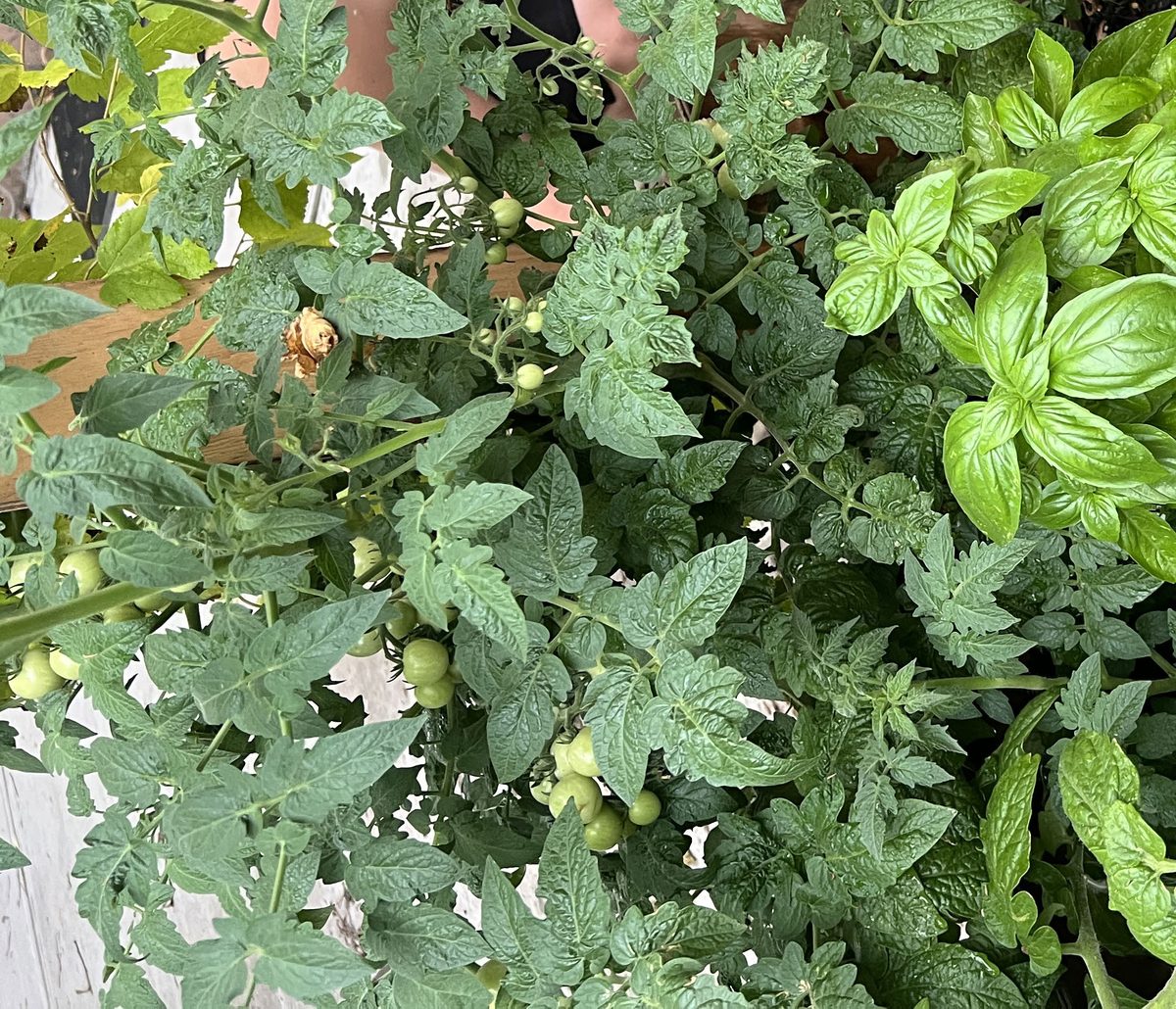
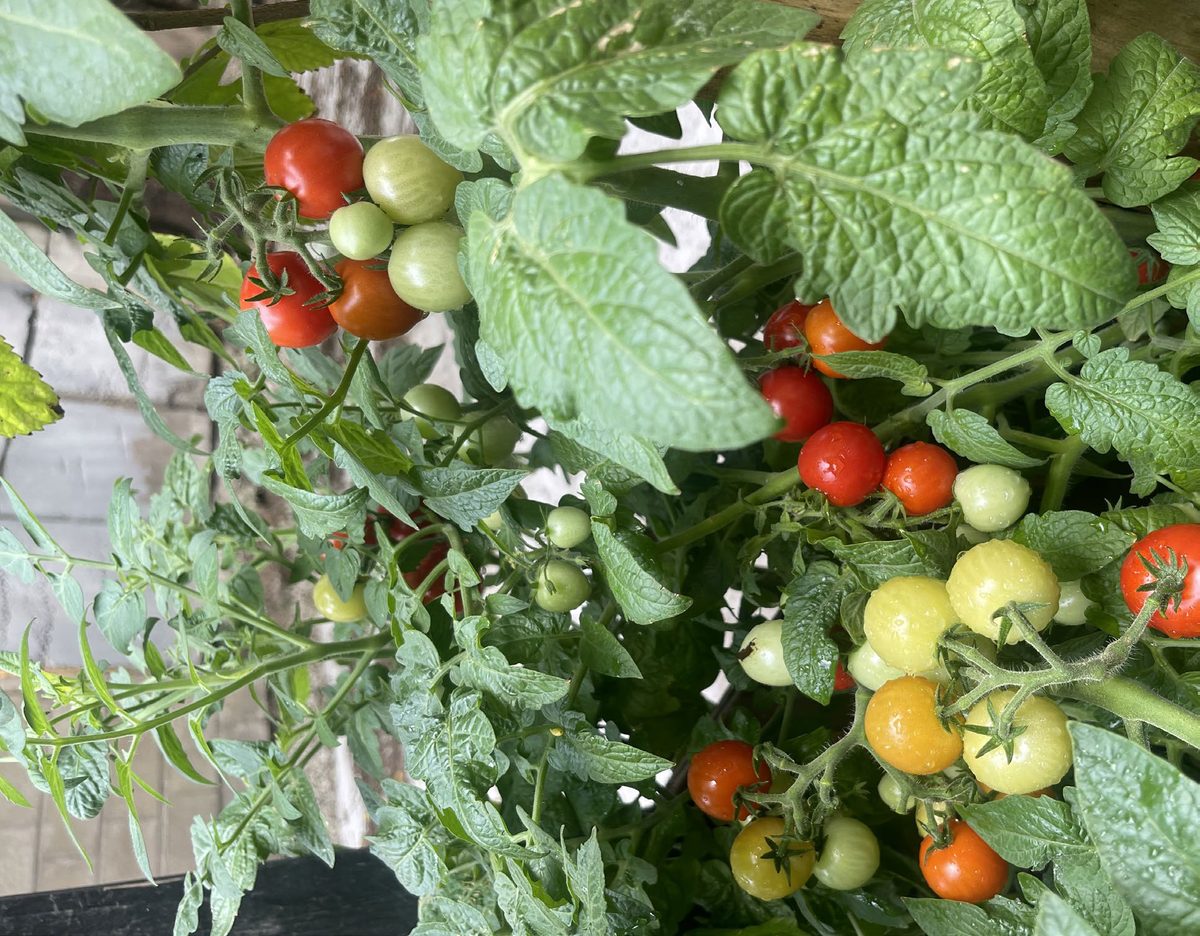
Built from reclaimed wood and a found pallet, the garden was planted in April 2024 using pre-seeded starter plants and direct sowing. By mid-June, strawberries, peas, and tomatoes were producing, with carrots and beets emerging. By mid-July it reached abundance — tomatoes, beans, strawberries, root vegetables, basil, thyme, marigolds, and native flowers thriving.

Maintained in a private setting, the garden was sustained through daily watering, observation, and adaptation, prioritizing soil health, companion planting, and the continuous labor that supports collective growth over time. After it moved to a public street, that steady care thinned — and the record below traces what followed.

Private stewardship

  1. 04 / 14 / 2024

    Garden built & planted

    Reclaimed wood, found pallet, mixed sowing

  2. Flowering started

  3. Fruiting started

    Tomatoes, strawberries, peas

  4. 07 / 09 / 2024

    Abundance

    Beans, roots, herbs, marigolds, native flowers

Public site

  1. 09 / 05 / 2024

    Moved to public space

  2. Tomatoes picked by community

    Some neighbors shared in the harvest

  3. Strawberry & lavender stolen

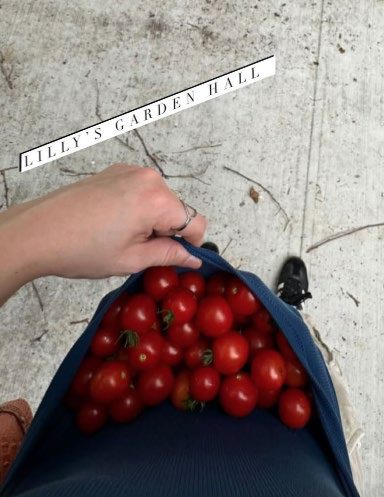
  4. All tomatoes picked — ripe and not

  5. Daily trash removal begins

  6. Metal trellises stolen · graffiti on planters

  7. 10 / 15 / 2024

    Plants pulled from the bed
Growth
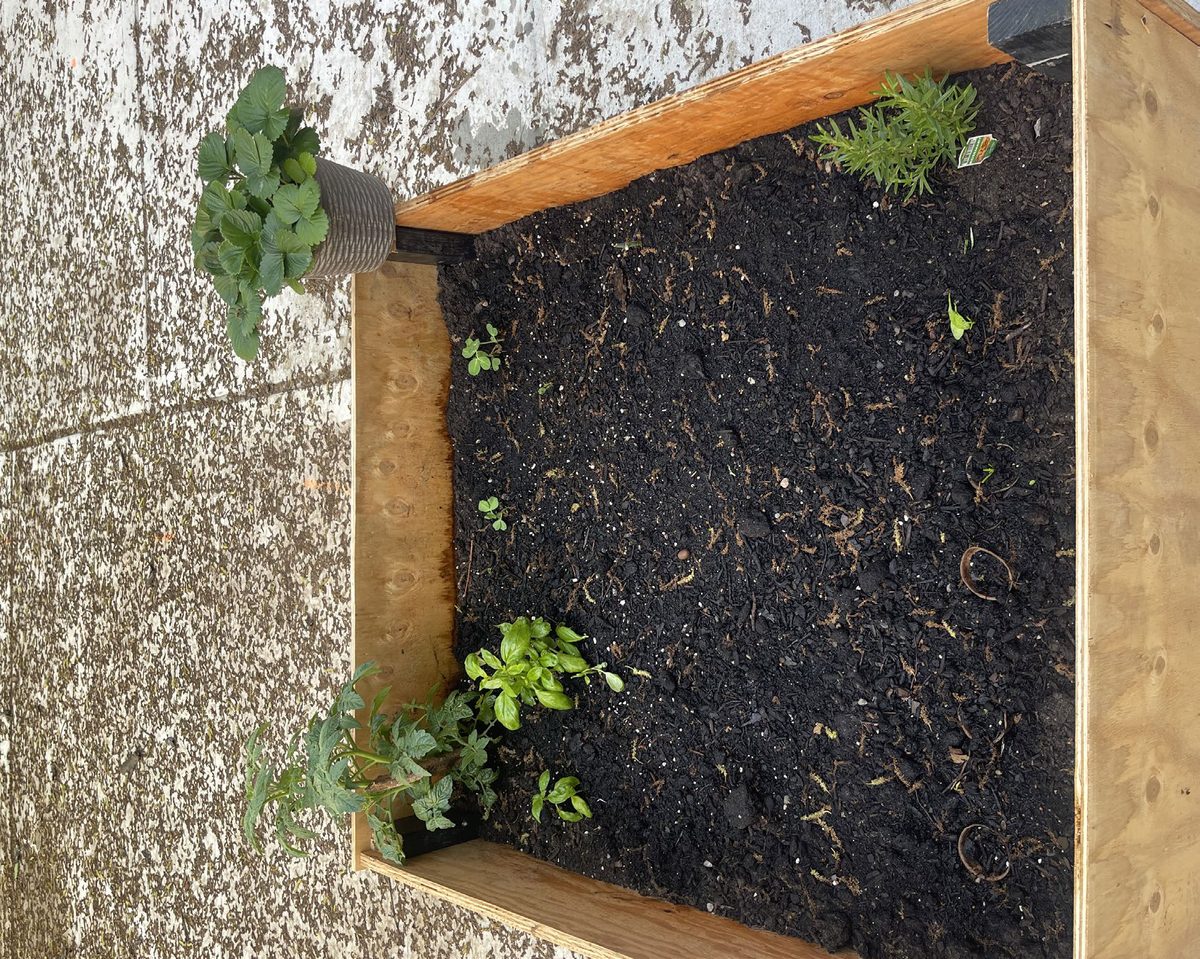
Freshly planted bed with dark soil and small seedlings.
Planted · 05/14/2024
Bed filling in with green tomato plants and basil.
Fruiting started
Clusters of ripening red and yellow cherry tomatoes.
Abundant fruiting · 08/25/2024
Hands holding a shirt full of harvested cherry tomatoes on a street.
Moved to public space · 09/05/2024
Urban Site Activation
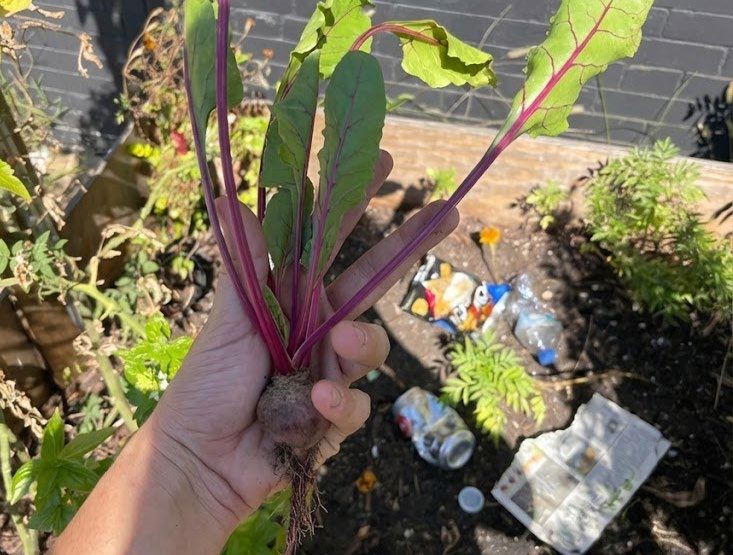
A hand holding a pulled beet above soil scattered with cans and litter.
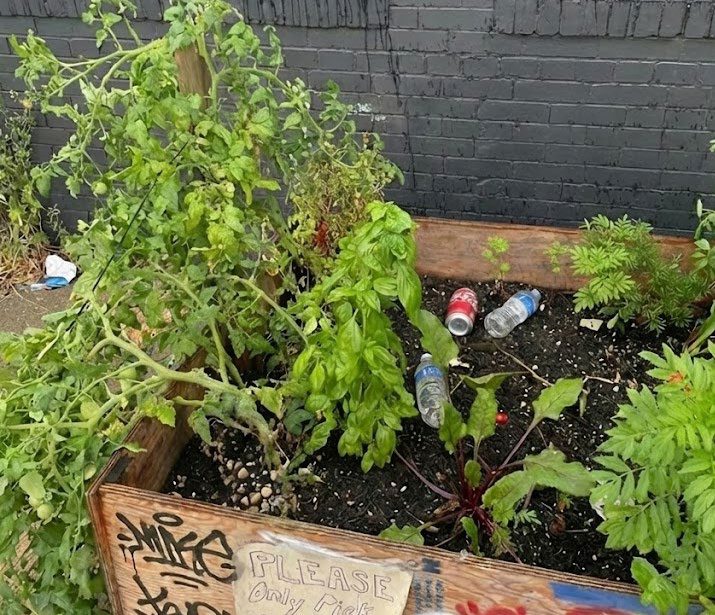
The planter on the street with plastic bottles and trash among the plants.

When relocated to a public street, the garden was exposed to unregulated human interaction and environmental pressure. Early observations included premature harvesting of fruit and vegetables, removal of potted plants, and daily deposition of trash. Structural elements, including trellises, were taken, and soil and planter integrity were gradually compromised.

Some community members engaged positively — particularly families with children, who were inspired to plant neighboring tree beds, and local residents who shared in harvesting.

This phase highlights the fragility of care-based systems when responsibility is distributed: ecological abundance depends not only on access, but on sustained stewardship and the social infrastructure that supports it.

A soft grey sky of layered clouds.

Thank you

For research collaborations, commissions, installations, and public-art projects.

Skye Reich

Interdisciplinary artist — ecology, materials, and public interaction.

Work

Contact